
Full-spectrum LED lighting isn’t a marketing badge. How to read an SPD curve, why CRI alone misses bad reds, and what RG0 does and doesn’t tell you.Now people are more and more pay attention to quality of light ,especially full spectrum for
Why full-spectrum lighting matters more than ever
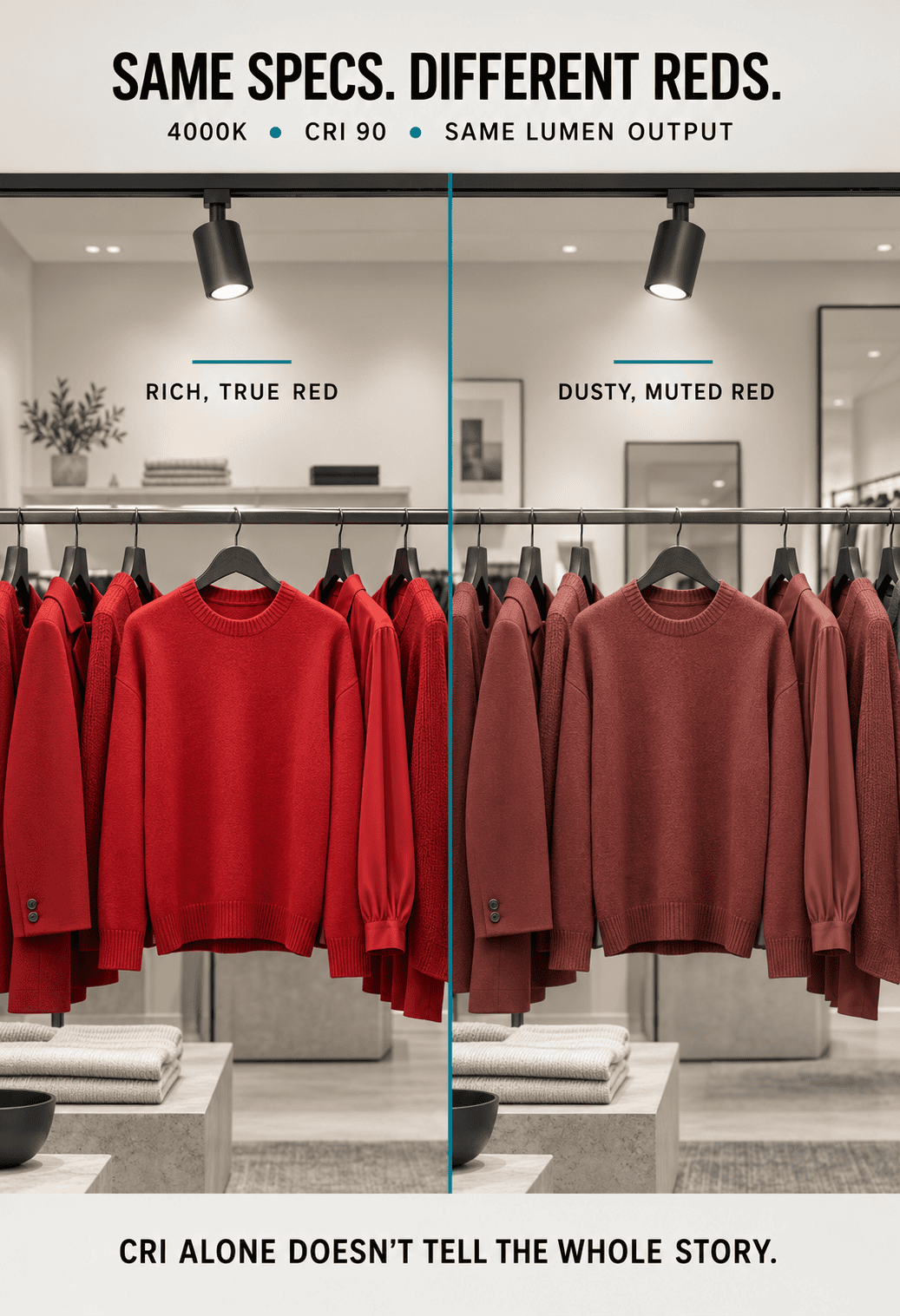
Two lamps. Both 4000K. Both CRI 90. Same lumen output on the datasheet. Hang them over a rack of clothing and one of them makes the reds look like reds, while the other turns them into a dusty, slightly sad version of themselves.
Nothing on either spec sheet explains the difference. The answer sits in the spectrum, and the spectrum is the one thing most spec sheets leave out.
That gap between what a datasheet claims and what a room actually looks like is why full-spectrum LED lighting has moved from a talking point into a real line item on project specifications. Retail, hospitality, healthcare, education, homes. Anywhere somebody is making a judgement based on how something looks.
The term gets thrown around loosely, though. So before it goes on a spec, it’s worth knowing what it means, how to measure it, and where it genuinely pays for itself.
What "full spectrum" actually means?
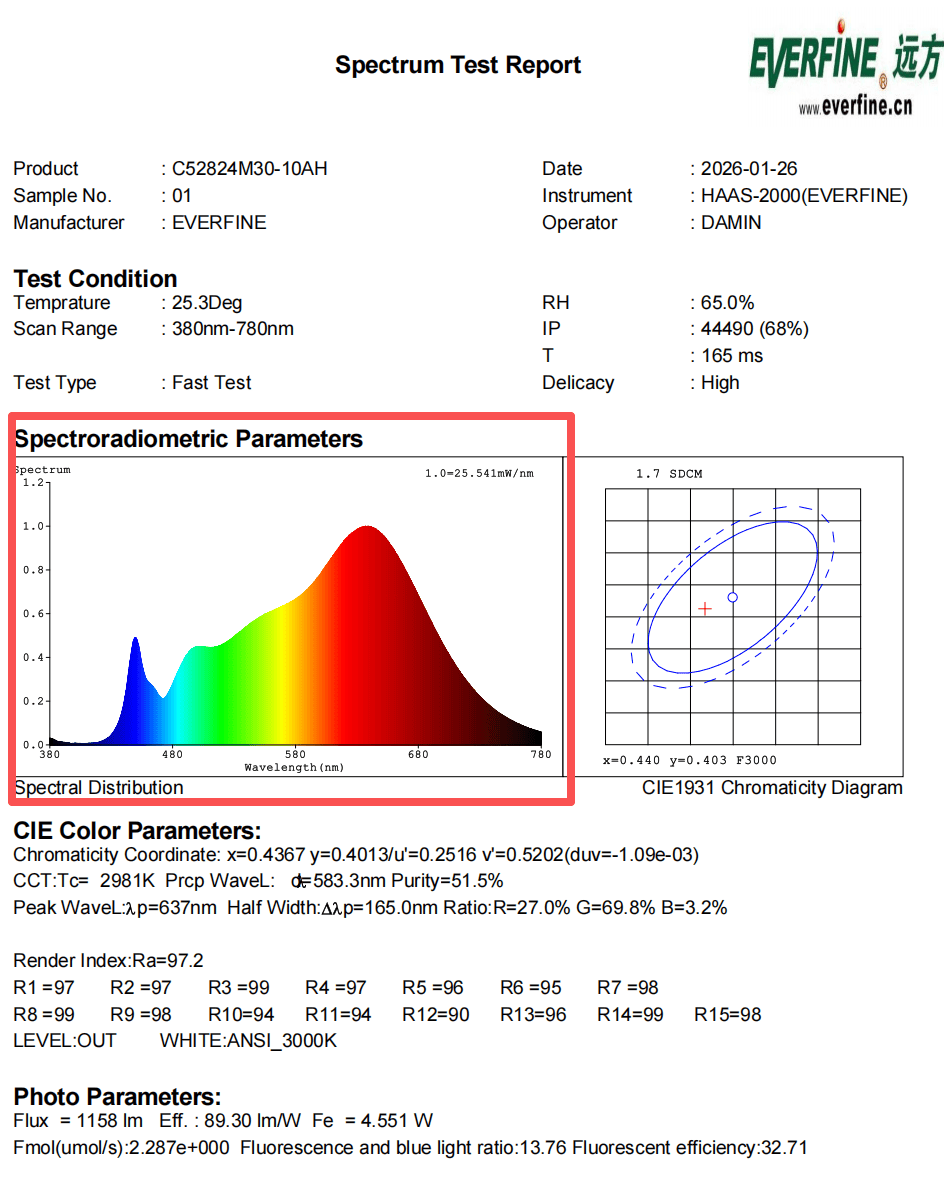
Every light source has a spectral power distribution, or SPD. It’s a graph of how much energy the source puts out at each wavelength across the visible range. Sunlight’s is broad and continuous, although it never sits still: it shifts with the hour, the weather and where you are on the planet.
A full-spectrum LED doesn’t copy sunlight. It does something more modest. It fills in the gaps that a conventional white LED leaves behind.
Most white LEDs are a blue chip under a yellow phosphor. It’s cheap, it’s efficient, and it produces a spectrum with a tall blue spike and a long trough through the cyan and deep red. That’s fine for lighting a corridor. It’s less convincing when the thing being lit is raw silk, a plate of food, or somebody’s face.
Now the awkward part, and it’s worth saying plainly: nobody has defined “full spectrum.” There’s no IEC or CIE document setting a threshold for the term. Two suppliers can use it and mean completely different things. On its own, the phrase tells you almost nothing. The SPD curve tells you everything.
That’s also why colour temperature doesn’t settle the question. CCT describes how the light itself looks. It says nothing about what’s behind it.
Why it's on the agenda now
Most of us are indoors, under this stuff, all day
People move between daylight and electric light a dozen times a day. The mismatch gets more obvious when one of the two has holes in it.
Full-spectrum lighting is not daylight and shouldn’t be pitched as a substitute. It just makes the electric side less of a compromise, which matters most in spaces that are occupied for long stretches or where daylight is limited.
Colour has become a buying decision
In a fashion store the customer is judging fabric colour. In a hotel it’s food, timber, stone and skin. In a gallery it’s the difference between two pigments that were never meant to be seen under a blue spike. In a home it’s artwork, wood finishes and faces that shouldn’t look grey at eight in the evening.
The U.S. Department of Energy’s colour characteristics factsheet makes the basic point: SPD affects both how the light appears and how objects in it are rendered.
Get the spectrum right and you get:
- Skin that doesn’t look grey
- Reds that stay red
- Less distance between how a product looks in-store and how it looks outside
- Fewer cameras needing rescue in post
For retail and hospitality work, those aren’t aesthetic niceties. They change how customers read both the product and the room.
CRI stopped being enough
Ra is the average of eight pastel test colours, R1 through R8. That’s the whole calculation. Saturated red sits at R9, and R9 is not in the average.
So a lamp can honestly claim CRI 90 while returning an R9 in the low twenties, which in practice means every red in the room is being fed through a gap. We’ve had customers send us a competitor’s “CRI 90” lamp for comparison, and the R9 came back under 20. On paper it looked identical to ours. In a fitting room it wasn’t close.
TM-30 is the better instrument. It’s built on 99 colour samples instead of eight, and it gives you two numbers rather than one: Rf for fidelity, Rg for saturation, where 100 is neutral, above 100 lifts saturation and below flattens it. The current version is ANSI/IES TM-30-20.
A few more worth asking for:
- Duv— how far the light sits above or below the Planckian locus. ANSI C78.377 allows ±0.006. Beyond that, the light starts reading green or pink.
- SDCM— batch-to-batch consistency. Three steps is a reasonable ask. At five, you start seeing two lamps in the same ceiling disagree with each other.
- The SPD curve itself.Always the SPD curve.
One caveat: higher fidelity isn’t automatically the goal. Some retail clients deliberately want a small saturation lift on specific product categories. The spectrum should serve the visual result you’re after, not a number on a sheet.
Full spectrum doesn't mean cold and blue
The most common pushback we get is “I don’t want that cold blue light in here.” Fair worry, wrong assumption. Full spectrum is about distribution, not colour temperature. A 2700K full-spectrum lamp stays warm. It just doesn’t carry the cyan trough and the weak red tail.
- Warm (2700–3000K) suits hotels, restaurants and homes.
- Neutral (3500–4000K) suits retail, studios and general commercial.
- Cooler (5000K and up) is worth considering for daytime task work and some education settings.Light also does more than let us see. CIE formally recognises light as a synchroniser of the human biological clock, and CIE S 026 sets out how to measure ipRGC-influenced responses. But the effect depends on spectrum, intensity, duration, timing and how much of it actually reaches the eye. Anyone promising better sleep from a lamp alone is selling you a concept. That’s a line worth holding, particularly for anything exported into the EU.
RG0: read the fine print
RG0, also called the Exempt Group, comes from photobiological safety testing under IEC 62471. That standard covers optical radiation hazards from lamps and lamp systems: blue light, UV, infrared, thermal. An RG0 result means the tested product showed no photobiological hazard under the conditions it was tested in.
Four things it doesn’t mean:
- It doesn’t mean no blue light. Blue content is what makes a white LED white in the first place.
- It isn’t “blue-light-free.” That phrase is marketing, not a classification.
- It says nothing about colour quality. An RG0 lamp can still render red badly.
- It isn’t a property of the lamp in the abstract. The result belongs to a test report with a distance and operating conditions attached. Change the distance and you can change the risk group.
Worth knowing which standard the report was issued under. IEC 62471:2006 is the general one, but IEC 62471-7:2023 now deals specifically with light sources that mainly emit visible radiation, which covers most of what we make. IEC/TR 62778 handles blue light assessment for complete luminaires.
Colour quality and photobiological safety are related questions. They are not the same question, and you have to ask both.
The bit nobody puts on the datasheet
Full spectrum costs you something.
Push R9 up and widen the spectrum and you’re typically giving up somewhere between 5 and 20 per cent in efficacy, compared with a standard 80 CRI chip at the same CCT. You’re converting more blue into wavelengths the eye weights less heavily. Warm CCTs cost more than cool ones. And it runs hotter, which matters more than people expect inside a sealed GU10.
None of that is a reason not to do it. It’s a reason to budget the wattage, the driver and the thermal headroom at the start, rather than discovering the shortfall at 90% design sign-off.
Where it earns its money
Retail and showrooms. Clothing, cosmetics, jewellery, fresh food. The commercial argument is simple: fewer “it looked different in the shop” returns.
Hotels and restaurants. Warm CCT with high fidelity. Food and skin have to look right, and the room still has to feel like a room.
Galleries and museums. Fidelity plus UV content plus conservation limits. Spectrum, lux and exposure hours have to be evaluated together, per application.
Homes. Artwork, timber, faces. You don’t have to change the household’s colour-temperature preference to get the benefit.
Studios and content spaces. A balanced spectrum helps colours reproduce on camera, but flicker and frame-rate compatibility will bite you long before spectrum does.
Healthcare, education and offices. High colour quality helps here, but glare, illuminance, timing and flicker matter just as much. Full spectrum is one input into a lighting strategy, not the strategy.
Full-spectrum GU10 lamps
GU10s do concentrated accent work, which means their spectrum gets examined at close range on exactly the things that matter: product, artwork, food, faces.
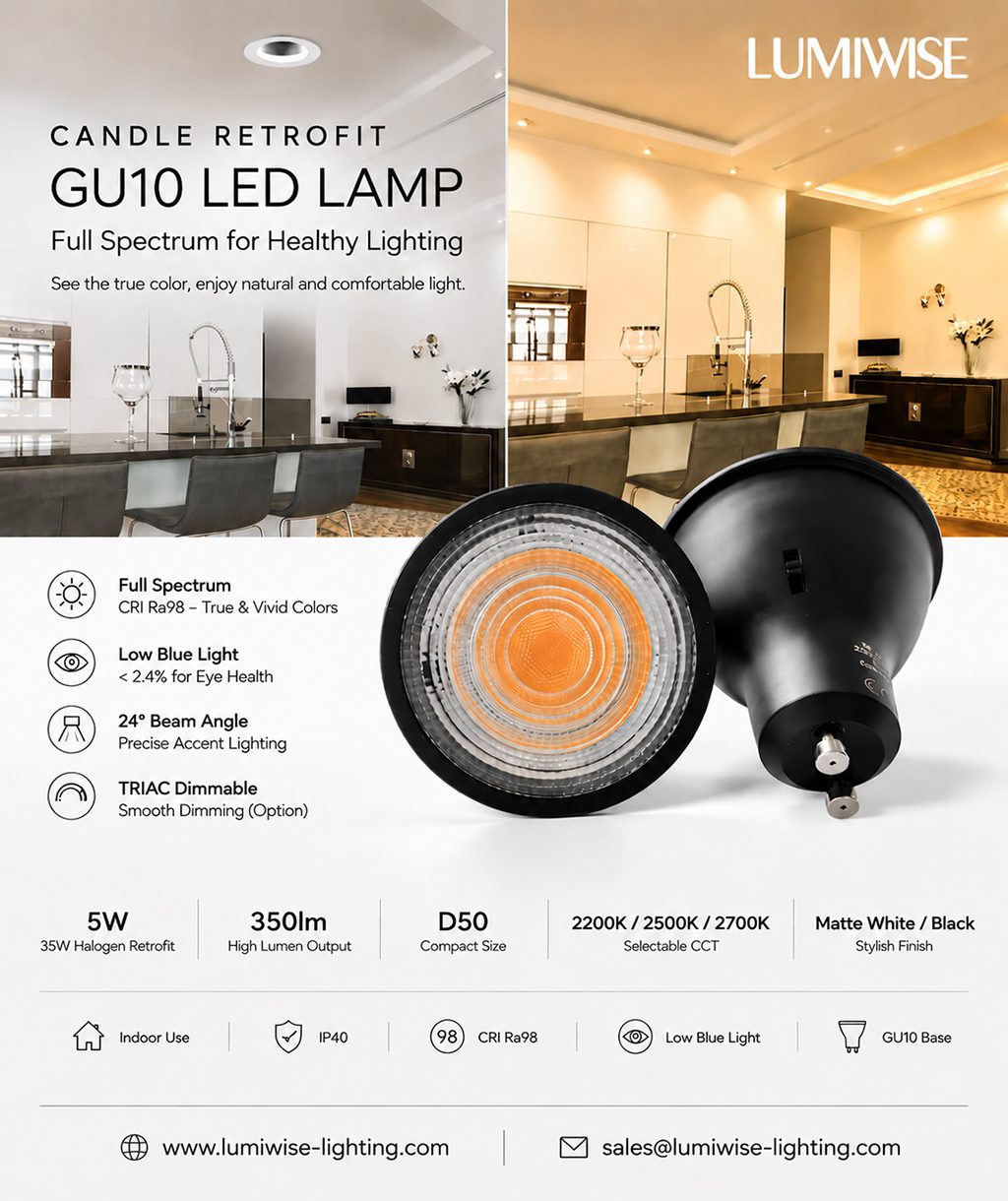
A custom full-spectrum GU10 can be specified on CRI 95 or above, an explicit R9 target, TM-30 Rf and Rg, CCT, SDCM, beam angle, dimmable or fixed output, low-flicker driver, and RG0 subject to testing on the final build.
The catch is thermal. A GU10 is a small can with a driver crammed into it. Chip, optics, heatsink and driver have to be designed as one thing, because a good LED in a bad thermal design is still a bad lamp, and it will drift in colour long before it dies.
How to specify it, so you get what you asked for
Don’t send a supplier an email that says “full spectrum please.” Send this below:
- CCT and tolerance
- Minimum Ra, and minimum R9 as a separate line item
- TM-30 Rf and Rg targets
- The SPD curve from the actual LED being used
- Maximum SDCM
- Flicker limits. Ask for PstLM and SVM figures. EU Ecodesign Regulation 2019/2020 sets limits for light sources placed on the European market.
- Photobiological safety classification, plus which standard and at what measurement distance
- Delivered lumens and system efficacy in lm/W, not LED-package lumens
- Dimming protocol and compatibility
- Tc point temperature, lifetime claim and warranty terms
some may be not tested well,but we need to know to identify from whihc aspects.
Then get physical samples. A mock-up with the real materials, the real finishes and a few human faces under the actual fixtures will settle in one afternoon what months of datasheet comparison won’t.
What we do at LUMIWISE
We make LED fixtures, and a growing share of what we ship is full-spectrum GU10 lamps and COB strips. We don’t keep one house spectrum that goes into everything. We start from the application and work backwards to the measurable targets.
Spectrum quality, colour fidelity, visual comfort, optics, thermal behaviour, efficacy and photobiological safety all pull against each other, and the right balance for a showroom in Milan is not the right balance for a hotel in Santiago. Tell us what’s being lit and what it needs to look like, and we’ll tell you what’s achievable and what it costs you in watts or in money.
Full spectrum is a useful idea bolted to a vague term. It isn’t one number, and it isn’t a health claim.
Ask for the SPD. Ask for R9 on its own line. Ask what standard the RG0 report was issued under and at what distance. Then go and look at the thing in person.
Those four questions will tell you more than any brochure.
Looking for a custom full-spectrum GU10 lamp, COB LED strip or LED fixture? Send us the CCT, the colour-rendering targets, the RG0 requirement and what’s being lit.
Website: www.lumiwise-lighting.com Email: sales@lumiwise-lighting.com
Frequently asked questions
Is full-spectrum LED lighting the same as sunlight?
No. It aims for broad, balanced output across the visible range, but it doesn’t reproduce every characteristic of daylight. Daylight also changes through the day and with the weather, which no fixed light source does.
Is a full-spectrum LED always CRI 95?
Not necessarily. The two ideas are related but not identical. Check the measured Ra, R9, TM-30 data and SPD curve.
Does RG0 mean there is no blue light?
No. It’s a photobiological safety classification under defined test conditions. Every white LED has blue content,it is just different ratio of blue light, better blue light ratio <2.4% ,premium <2%
Can full-spectrum lighting be 2200K,2700K or 3000K?
Yes. Full-spectrum LEDs are made in warm, neutral and cool CCTs. The term refers to the spectral distribution, not one specific colour temperature.
What should buyers request from a supplier?
The SPD curve, Ra, R9, TM-30 data, CCT tolerance, SDCM, flicker figures, and the photobiological safety test report with its test distance.