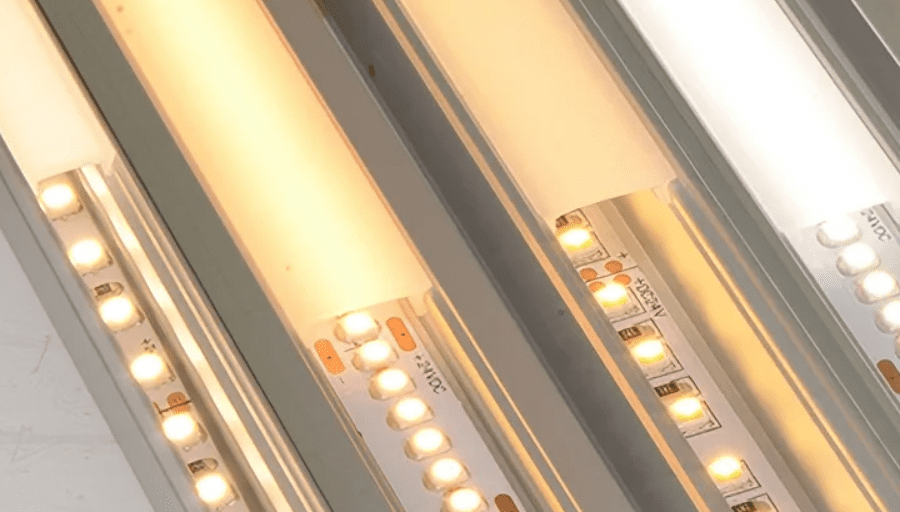

Compare flexible silicone and rigid aluminum LED wall washers for curved façades, straight walls, optics, heat, installation and outdoor protection,this chapter will guide how to choose right led wall washer for morden architectual lighting .
Flexible Silicone vs. Rigid LED Wall Washers: Which Should You Specify?
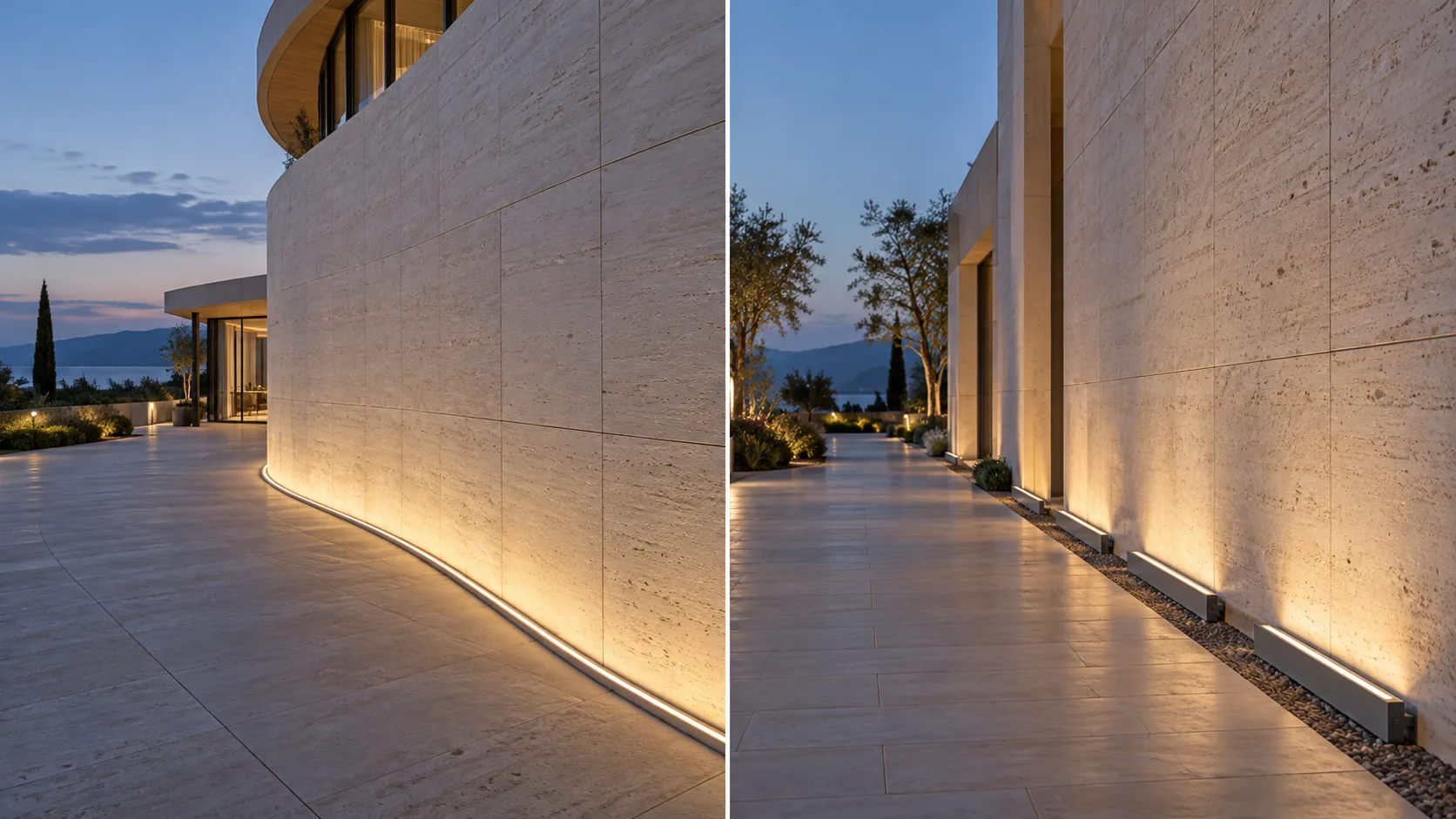
Illustrative visualization: curved façade with flexible lighting at left; straight façade with separate rigid bars at right. This is a design comparison, not a photograph of a LUMIWISE project or a measured optical test.
A wall washer can transform a plain surface into part of the architecture. But a beautiful rendering does not answer the practical questions: Will the luminaire follow the wall? How will the beam look at the next joint? Where will the cable and driver go? What happens when one section needs service?
Flexible silicone and traditional rigid aluminum wall washers can both create effective façade lighting. The better choice depends on the geometry, required beam, output, exposure and maintenance plan. For a curved or irregular line, a flexible wall washer often simplifies the visible installation. For a long, straight run with demanding output and accessible fixture replacement, a rigid system may be easier to specify and service. Neither construction guarantees a better wall wash by itself: compare photometric files and a mock-up at the actual mounting distance.
What is the difference?
A flexible silicone wall washer houses the LED circuit and optical structure in a bendable, sealed body. Unlike a decorative LED neon strip that mainly creates a glowing line, an optical wall washer is designed to direct light onto a nearby surface. The permitted bending direction and minimum radius depend on the exact model; “flexible” does not mean it can be twisted or folded in any direction.
For examples of available forms, see the LUMIWISE flexible wall washer range and 3D bending wall washer range.
A rigid wall washer generally uses a straight aluminum housing with a fixed lens or optical assembly. Individual bars are mounted in a line, with the mechanical position and aiming set by brackets or other mounting hardware. Its housing provides a defined mounting plane and a route for heat to leave the LEDs, but the full thermal result still depends on the fixture design and installation.
At a glance
| Design question | Flexible silicone wall washer | Rigid aluminum wall washer |
|---|---|---|
| Curved outlines | Can follow compatible curves within the specified bending direction and radius | Straight modules approximate the curve; more joints or shorter fixtures may be needed |
| Long straight elevations | Can create a continuous-looking line, subject to electrical sectioning and installation details | Well suited to aligned straight runs and repeatable aiming |
| Beam control | Depends on the integrated lens, orientation and available optics | Depends on the fixture’s lens, aiming range and available optics |
| Heat management | Must be checked at rated power and in the proposed mounting condition | Aluminum housing can aid heat dissipation; check the tested luminaire performance |
| Outdoor protection | Check the complete assembly, including cut ends, leads and connectors | Check the complete fixture, cable entries, connectors and junctions |
| Service | Plan how to access and replace a section in a continuous installation | Individual bar replacement may be straightforward if access is designed in |
The table describes typical design trade-offs, not a universal ranking. Product construction varies considerably.
1. Start with the shape of the building
For columns, arcs, sculptural forms and curved parapets, flexible silicone makes it possible to track the intended line without building a polygon from many straight fixtures. The result can look cleaner, especially where the luminaire is visible during the day. Confirm whether the chosen product bends horizontally, vertically or in both directions. Also check its minimum bending radius, cut length and mounting method against the actual drawing.
Illustrative visualization of a curved mounting line. Verify the actual model’s bending direction, minimum radius and mounting hardware before installation.
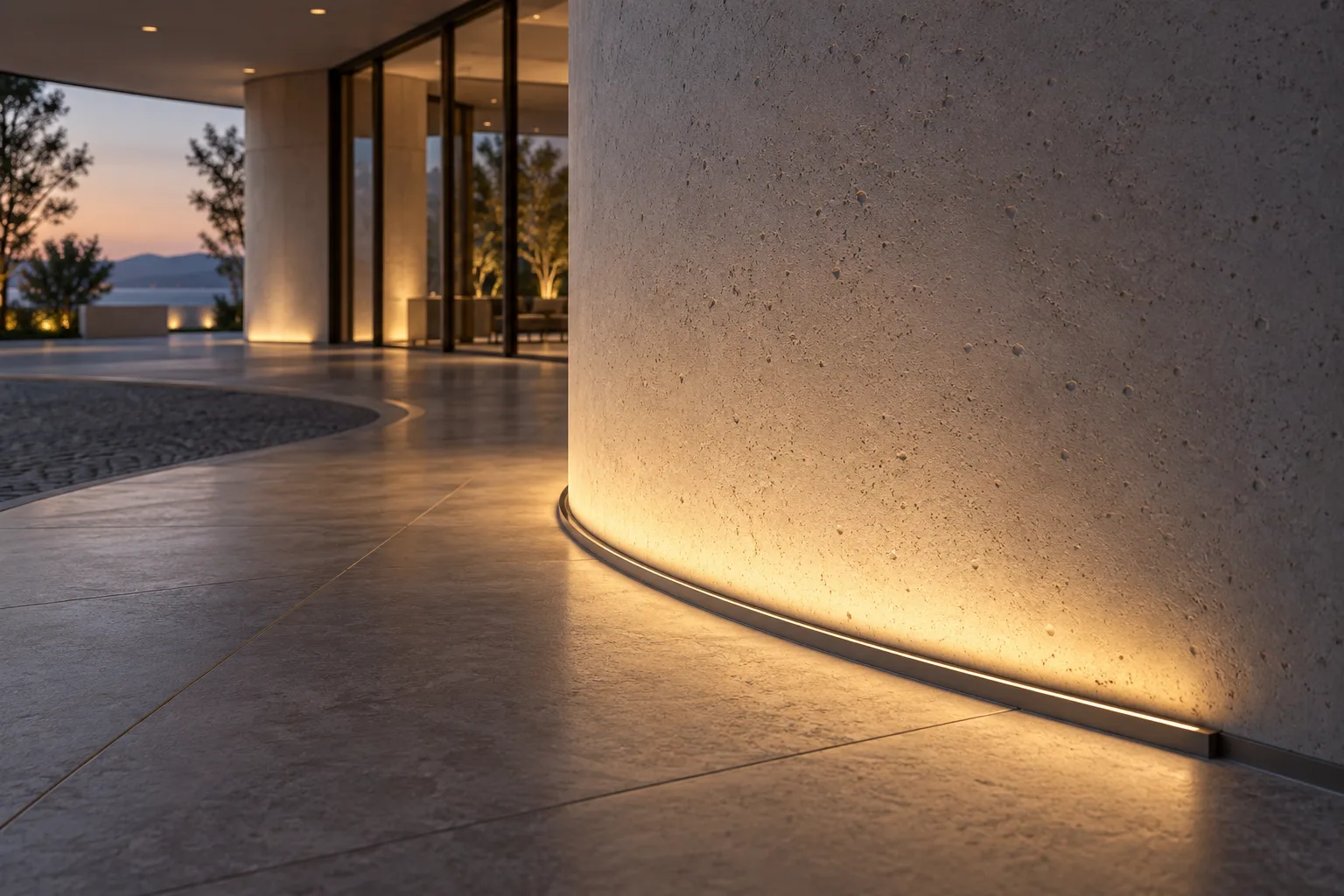
Rigid bars make sense on straight stone, concrete or metal elevations where alignment is controlled. At a curved corner, however, gaps between straight bars and changes in beam direction can become visible. A hybrid layout is sometimes the sensible solution: rigid fixtures on long straight sections and flexible sections at curves or transitions. Test the transition at night; matching nominal CCT alone will not make two different optical systems appear identical.
2. Compare the light on the wall, not just the watts per metre
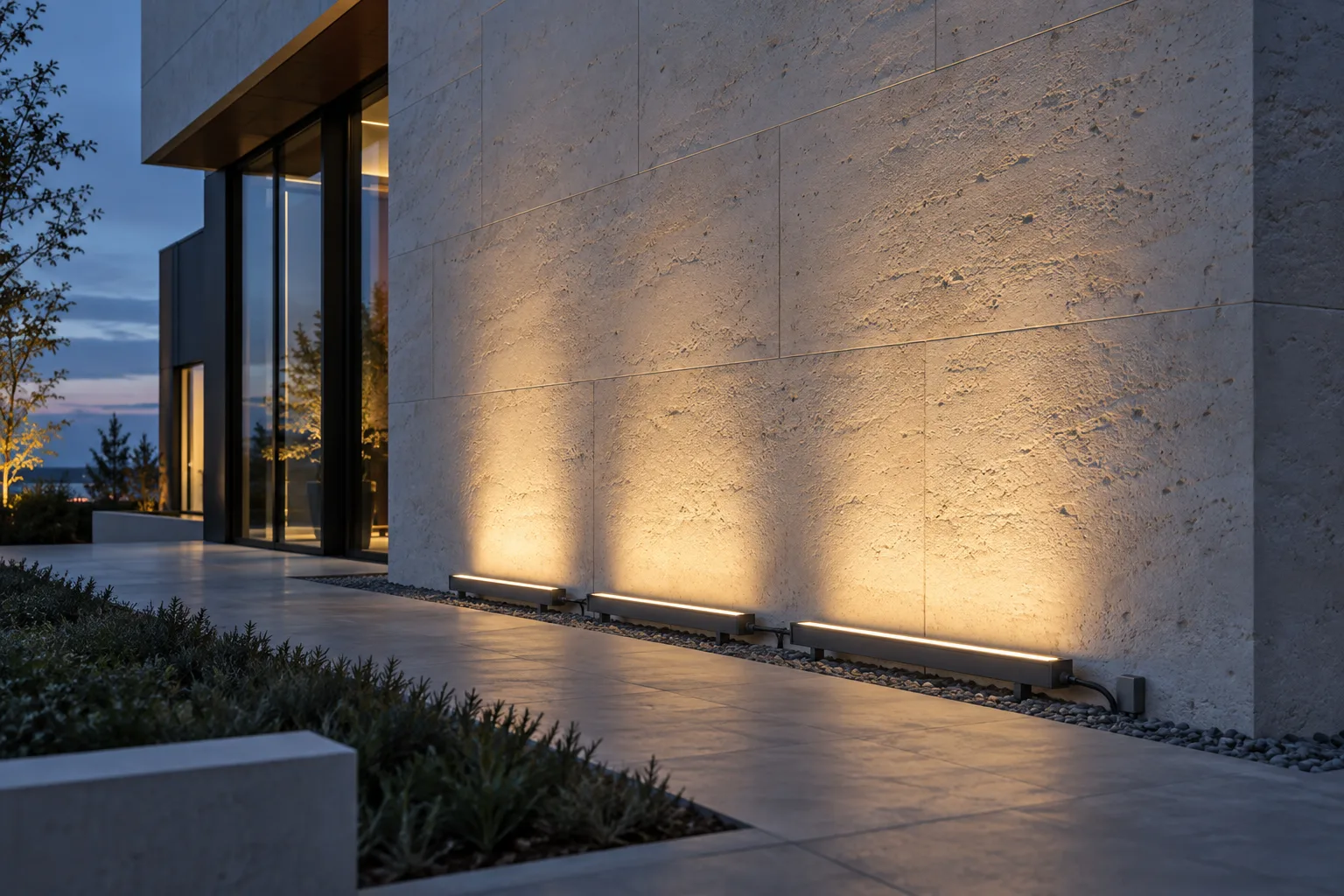
“Wall washing” usually aims for a relatively even field across the surface. “Grazing” places light close to the wall to reveal texture and relief. Either flexible or rigid products may be offered with optics for these effects. The result depends on beam distribution, setback from the wall, mounting height, tilt, wall reflectance and surface texture.
For more context on these effects, see the LUMIWISE architectural lighting design guide.
Ask for an IES or LDT photometric file for the exact configuration and model the supplier is quoting. Run the calculation at the real mounting position. Then make a short on-site mock-up that includes a connector and a change of direction. Look for bright spots, dark joints, unwanted spill into windows, glare from typical viewpoints and uneven color along the run. A single beam-angle number cannot show all of these effects.
3. Treat outdoor protection as a system detail
An IP rating on the luminaire body is useful, but outdoor reliability also depends on the finished assembly. Inspect factory-sealed ends, field cuts, cable exits, mating connectors, driver enclosures and drainage paths. A cut or re-terminated section needs a sealing process approved for that exact product. Avoid placing connections where water can stand, and allow an accessible route for maintenance.
For example, LUMIWISE lists its Elite Neon LED Flex Wall Washer 22 as a silicone-encapsulated, 24 V DC, IP67 product with dual-bending capability. Those figures identify that model; they do not automatically apply to every flexible wall washer or to an installation after field cutting. Specify the exact model and connection scheme in the bill of materials.
4. Check power, thermal conditions and control together
An aluminum housing can help a rigid luminaire conduct heat away from its LEDs. A silicone body behaves differently, so compare the manufacturer’s rated operating conditions, mounting instructions, ambient temperature range and lumen-maintenance evidence rather than assuming either type lasts longer. Thermal management matters because higher LED operating temperatures can accelerate light-output decline.
Next, draw the electrical sections. A long visible line is not necessarily one electrical run. Confirm supply voltage, rated watts per metre or fixture, maximum powered length, feed points, voltage drop, driver location and access. For tunable white, RGBW or pixel effects, document the precise controller protocol, addressing and cable topology. Signal or power segmentation can be planned without creating a visible interruption in the lighting effect, provided the layout and control mapping are coordinated.
5. Compare installation and maintenance over the project life
Flexible products can reduce the number of rigid-to-rigid joints along a curve, but they still need the specified mounting clips or channel, correct orientation and strain relief. A tight curve beyond the rated radius can damage the product or change the optical direction. Rigid fixtures need space for brackets, alignment and cabling, yet individual modules can often be identified and replaced without disturbing a whole line.
Compare the installed system, not the price of one metre: luminaire, mounting parts, drivers, controls, junctions, waterproof terminations, labor, commissioning and future access. The most economical option on a straight façade may differ from the most economical option around a curved entrance.
Which one should you choose?
- Choose a flexible silicone wall washer when the design follows a curve or irregular profile, a continuous-looking line matters, and the selected model’s bend radius, optics, power run and mounting method suit the project.
- Choose a rigid aluminum wall washer when the façade is predominantly straight, repeatable alignment and service access are priorities, or a particular rigid fixture provides the verified distribution and output the project requires.
- Use both when the building combines long straight elevations with curved features. Mock up the joint between systems and check color, beam shape and control behavior.
Before approval, ask the supplier for the exact-model datasheet, IES/LDT file, bending drawing where applicable, installation guide, wiring diagram and end-connection details. A sample tested on the real wall is worth more than a generic photograph.
Frequently asked questions
Is a flexible LED wall washer always better for a curved façade?
It is often easier to follow the curve, but only if its permitted bending axis and minimum radius match the geometry. For wide walls or demanding throw distances, compare its measured beam with a rigid fixture or a custom curved mounting system.
Does IP67 mean I can cut a flexible wall washer outdoors and leave the end exposed?
No. An IP claim applies to a tested configuration. Field cuts and re-terminations must follow the manufacturer’s approved sealing method, and the complete connection arrangement should match the site’s exposure.
Can a flexible wall washer deliver the same effect as a rigid wall washer?
Sometimes, but construction alone cannot establish equivalence. Compare the IES/LDT distributions, mounting position, wall illuminance, uniformity, spill and color in a mock-up.
Can a long flexible wall washer be one unbroken lighting effect?
Yes, a continuous visual effect can span multiple power or control sections when the sections and controller mapping are designed together. The allowable powered length is model-specific; it should never be inferred from the shipping reel length.
Discuss your façade with LUMIWISE
Send us the façade elevation, curve radius, mounting location, wall height, target color or effect, exposure conditions and available driver positions. LUMIWISE can help compare a flexible silicone wall washer with a rigid layout and prepare a project-specific optical and electrical proposal.
Contact: sales@lumiwise-lighting.com · www.lumiwise-lighting.com