. Don’t Choose by Wattage Alone
One of the most common mistakes is comparing floodlights only according to wattage.
For example:
100W ≠ guaranteed brightness
The actual light output depends on the fixture’s luminous efficiency.
A more useful calculation is:
Lumens ≈ Wattage × Luminous Efficiency
For example, theoretically:
100W × 150 lm/W ≈ 15,000 lumens
A more efficient floodlight can therefore produce similar useful light with lower power consumption.
2. Check Luminous Efficiency
Luminous efficiency is expressed as:
lm/W — lumens per watt
It indicates how effectively electrical power is converted into visible light.
For large commercial projects with hundreds of luminaires, improving lm/W can have a significant effect on electricity consumption.
This allows the fixture configuration to be matched to different project performance and budget requirements.
Why lm/W Matters
Higher Efficiency
↓
More Lumens per Watt
↓
Lower Energy Consumption
↓
Lower Operating Cost
3. Select the Correct Wattage
Floodlight wattage should be selected according to the application rather than choosing the highest power available.
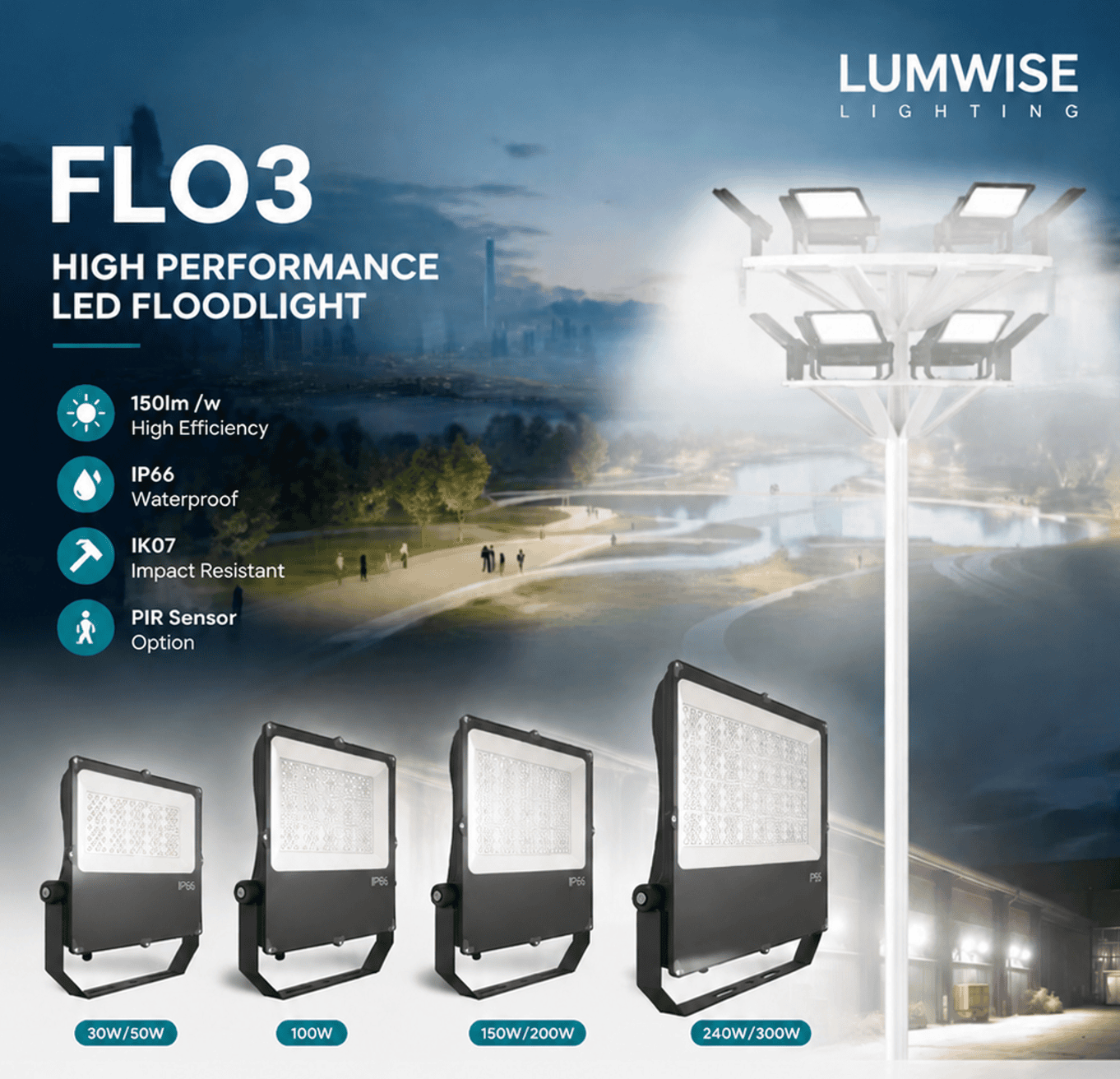
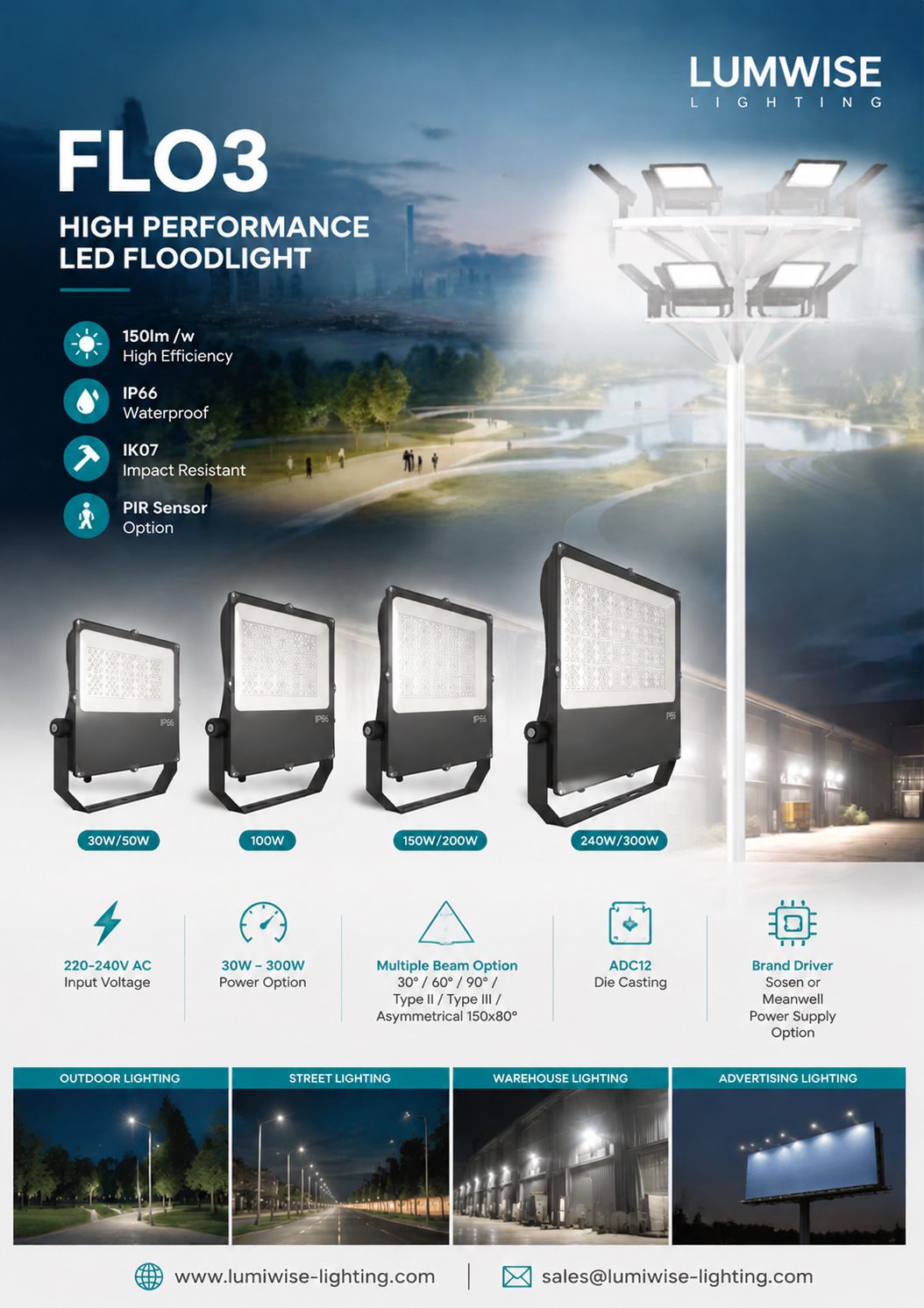
Lumiwise FLO3 configurations cover approximately:
30W–300W
with different housing sizes.
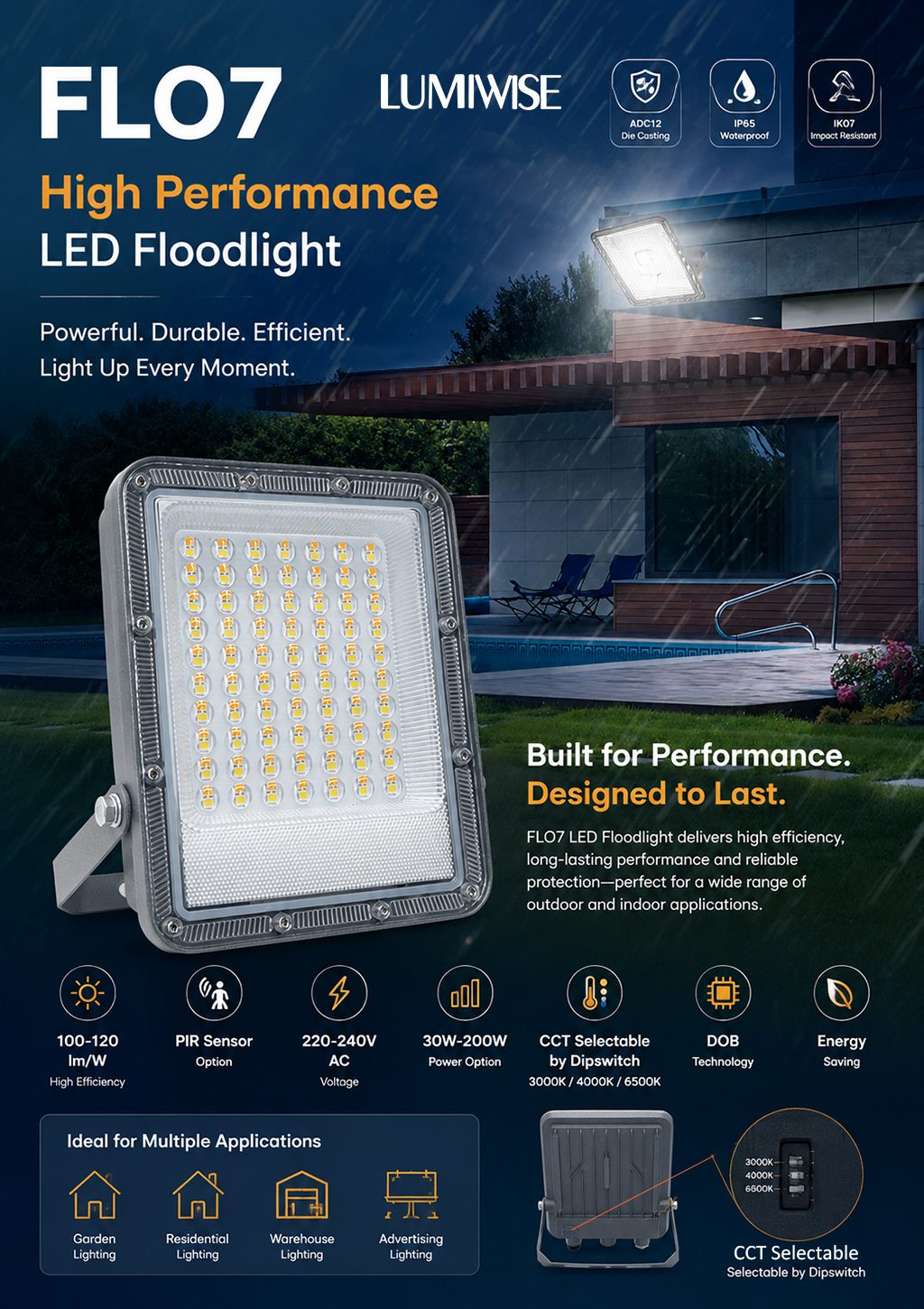
FLO7 extends the range for different configurations and larger-area applications.
Lower wattages may be suitable for:
Gardens • Entrances • Small signs • Residential areas
Medium wattages can be used for:
Commercial areas • Building surroundings • Warehouses
Higher-output versions can address:
Industrial yards • Large outdoor areas • High mounting positions • Large advertising installations
The final selection should be based on the required lighting result.
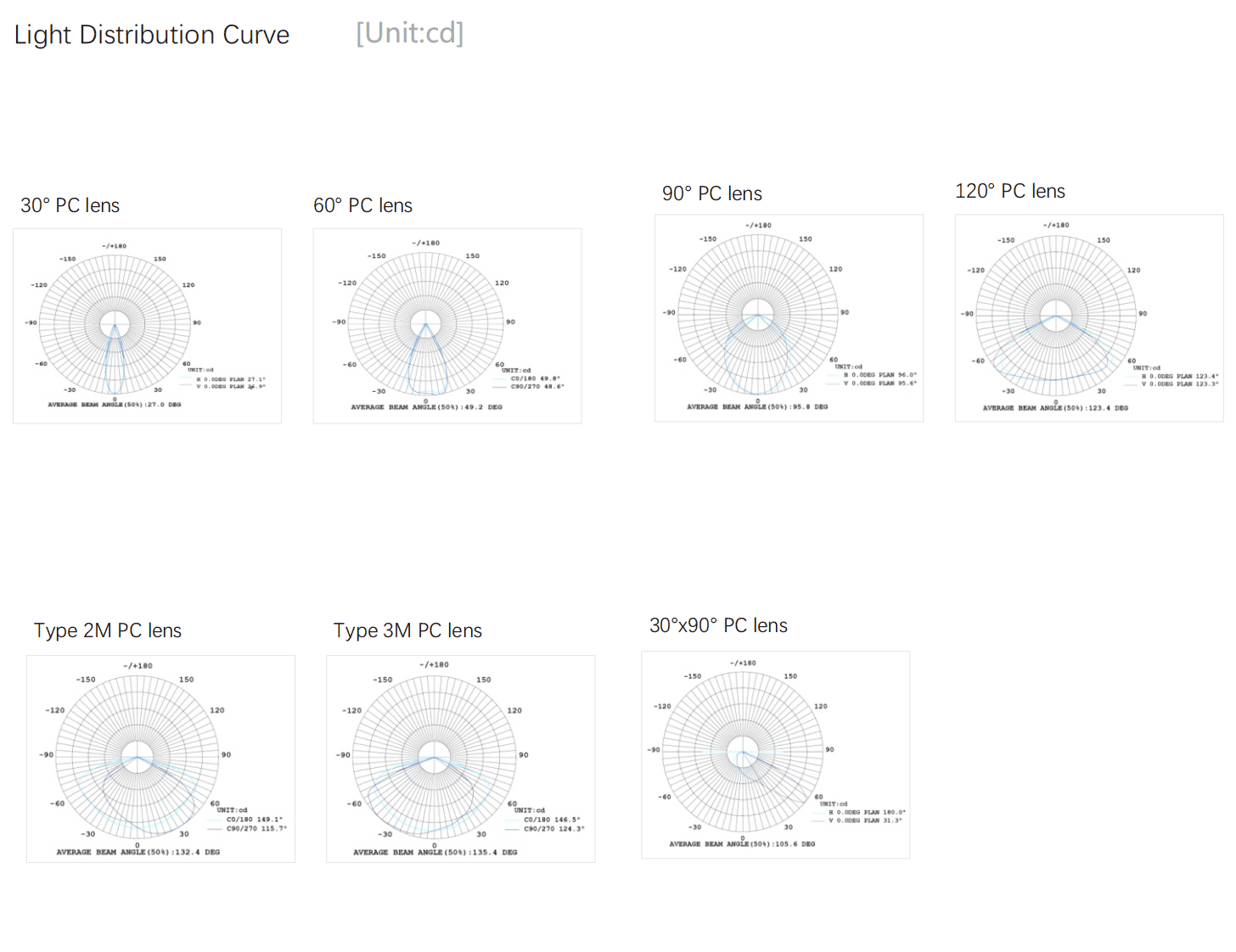
4. Beam Angle Is Just as Important as Wattage
Two floodlights with the same wattage can produce completely different lighting effects if they use different optics.
Narrow Beam
Concentrates the light over a smaller area.
Useful for longer throw distances or accent applications.
Medium Beam
Provides a balance between coverage and intensity.
Wide Beam
Distributes light across a larger area.
Suitable for many general area-lighting applications.
The Lumiwise FLO3 series offers multiple optical options, including:
30° | 60° | 90° | Type II | Type III | Asymmetrical 150×80°
depending on the selected configuration.
This provides greater flexibility for different project layouts.
5. Understand IP Ratings
Outdoor luminaires need protection against environmental exposure.
The IP — Ingress Protection — rating indicates the fixture’s resistance to solids and water.
For example:
IP65
The first digit, 6, indicates dust-tight protection.
The second digit, 5, indicates protection against water jets.
IP66
IP66 is also dust-tight but provides protection against more powerful water jets.
The Lumiwise floodlight range includes configurations such as:
FLO3 — IP66
and
FLO7 — IP65/IP66 depending on configuration.
The correct rating should always be selected according to the actual installation environment.
6.Choose a Reliable LED Driver
The LED driver is one of the most important components inside a professional floodlight.
It affects:
- Electrical stability
- Flicker performance
- Efficiency
- Power factor
- Dimming
- Protection
- Long-term reliability
Depending on the FLO3 configuration and project requirements, Lumiwise can provide options using established driver brands such as:
SOSEN or MEAN WELL
This gives project customers flexibility to specify the driver solution according to performance, certification and budget requirements.
7.CCT Selectable Floodlights Reduce Inventory
A useful feature of selected FLO7 versions is:
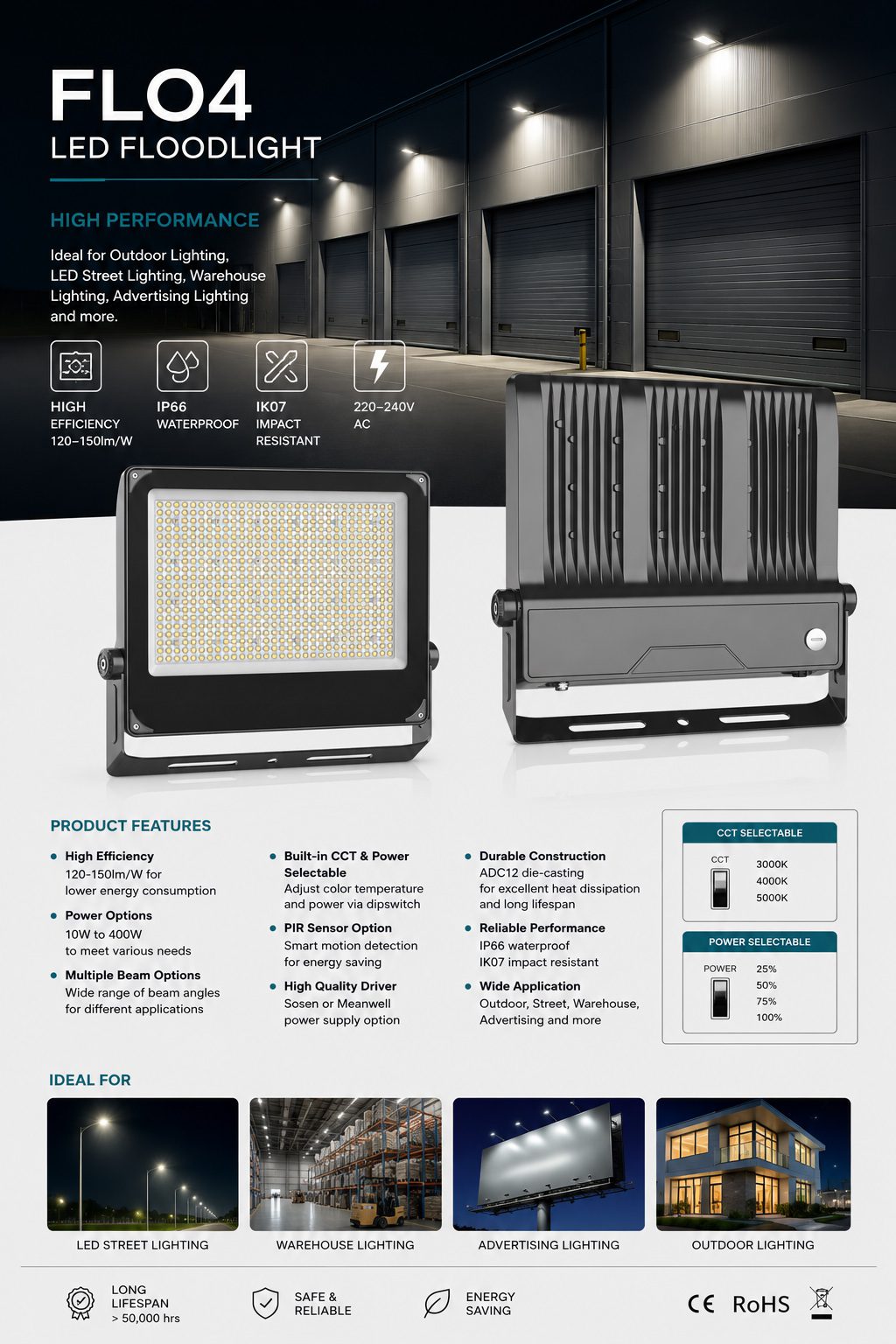
CCT Selectable by DIP Switch
For example:
3000K | 4000K | 6500K
Instead of stocking three separate floodlights, distributors and contractors can potentially use one configurable model for several applications.
3000K — Warm White
Suitable for gardens, residential areas and warmer architectural environments.
4000K — Neutral White
A versatile choice for commercial and general outdoor lighting.
6500K — Cool White
Suitable for applications requiring a cooler, high-visibility appearance.