
In the past, office lighting focused more on functionality—it only needed to meet illuminance requirements. However, with the rise of diversified office models (remote + on-site), increased spatial flexibility, and a greater emphasis on employee health and well-being, lighting systems are undergoing a transformation from “infrastructure” to “value-creating tools.”
The core requirements for lighting in modern offices include:
- Visual comfort: Reducing glare and flicker to protect employee vision
- Spatial coherence: Enhancing spatial structure and functional zoning through lighting
- Energy efficiency and intelligence: Reducing energy consumption and supporting smart dimming/motion-sensing control
- Design consistency: Lighting style must align with overall interior design.
- Maintenance convenience: Reduce maintenance frequency and labor costs.
In this context, LED linear lights, with their high flexibility, stability, and aesthetic adaptability, are increasingly becoming one of the most promising lighting products in office lighting systems.
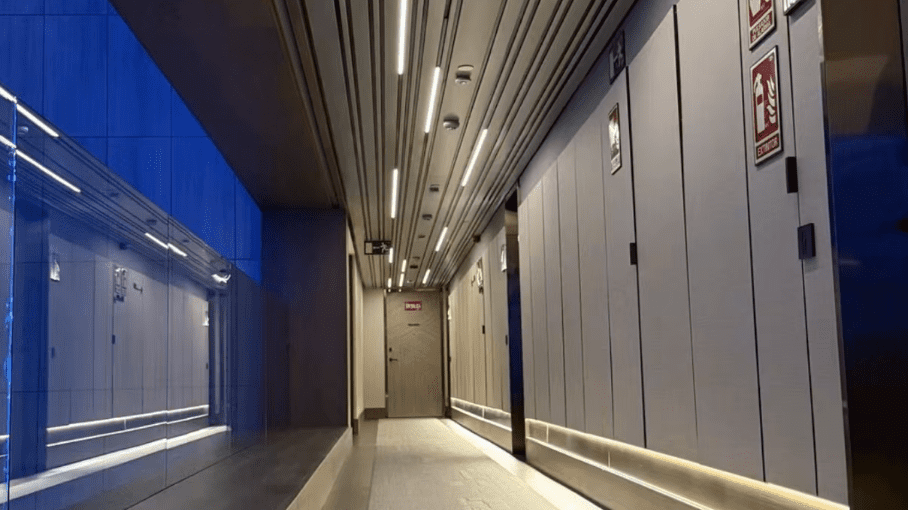
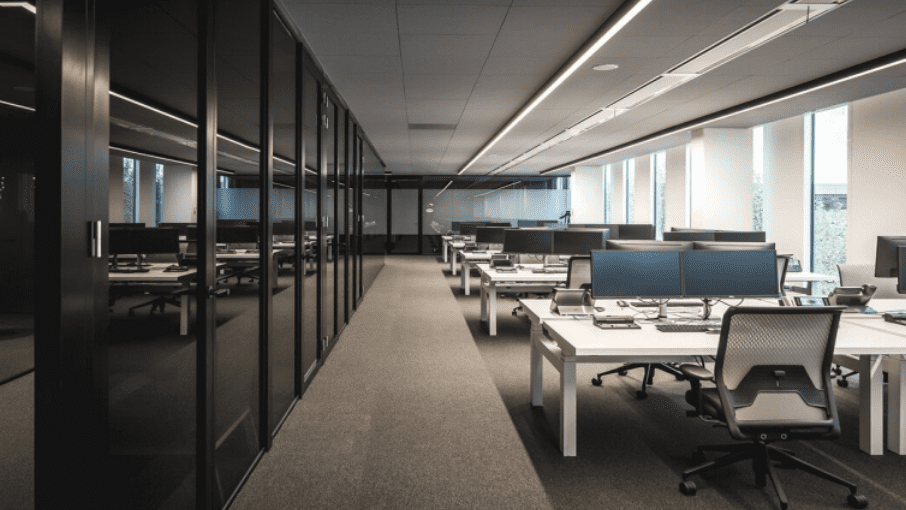
Compared to traditional grid lights or fluorescent tubes, LED linear lights offer greater system flexibility. They support multiple installation methods (suspended, recessed, and surface-mounted) and can be customized to suit the functional attributes of different office areas. Whether it’s high-efficiency open-plan workstations, quiet and serene meeting spaces, or aesthetically focused reception areas, LED linear lights provide a highly consistent, uniform, and comfortable lighting environment.

Comparison Between LED Linear Lights and Traditional Office Lighting Solutions
| Dimensionality |
Traditional Grid Light / Downlight |
LED Linear Light |
| Luminous Efficacy |
60–80 lm/W |
100–130 lm/W or higher |
| Light Distribution |
Point source, prone to shadows |
Uniform linear emission, comfortable and natural |
| Aesthetic Appearance |
Exposed fixtures with fixed form |
Sleek appearance, supports custom designs |
| Installation Flexibility |
Limited installation options |
Supports suspended, recessed, or surface mounting |
| Control Capabilities |
Basic on/off control |
Supports dimming, color tuning, and smart system integration |
| Energy Efficiency |
High energy consumption, short lifespan |
Over 60% energy savings, lifespan over 50,000 hours |
| Suitability for Modern Offices |
Poor adaptability |
Highly adaptable |
The specific advantages of LED linear lights can be summarized as follows:
1. Uniform light distribution reduces eye strain
LED linear lights typically feature a large light-emitting surface and a diffusive light diffuser, effectively eliminating local shadows and bright spots to create a soft, flicker-free lighting environment. In particular, the low-glare design with UGR < 19 is especially important in prolonged computer-based office settings.
2. High energy efficiency and low operational costs
Mainstream LED linear lights for office use typically achieve luminous efficacy of 130–150 lm/W, far exceeding traditional fluorescent lamps (approximately 60–70 lm/W). In today’s increasingly stringent energy-saving and environmentally friendly building standards (such as LEED and WELL certifications), such high-efficiency products are particularly favored.
3. Multiple color temperatures/color rendering options to suit different spatial atmospheres
Neutral white light at 4000K is recommended for office areas to maintain focus, while warm white light at 3000K can be used in meeting rooms to create a relaxed atmosphere. Products with CRI > 90 can also be selected to ensure accurate color reproduction of documents and drawings.
4. Flexible installation options with customization capabilities
The lights can be suspended, recessed, surface-mounted, or even connected in a continuous S-shaped wave pattern, allowing designers to create innovative layouts based on different spatial structures. The housing color, length dimensions, and control methods can also be customized for specific projects.
5. Supports smart control systems
Linear lights can easily integrate with control protocols such as DALI, 0-10V, KNX, Bluetooth Mesh, and wireless systems. When combined with sensors, they can achieve “lights on when people arrive, lights off when people leave,” which is both energy-efficient and enhances the intelligence of the space.
In summary, LED linear lights for offices are not only lighting tools but also integral components of space design, part of energy management, and vehicles for shaping corporate image. In today’s trend toward human-centric and intelligent office lighting, choosing LED linear lights is both a forward-thinking decision and the first step toward creating a competitive edge.